

Every Movement Tells a Story: Synapse SRT’s Motion Analysis Lab at Sawmill
Two athletes jump to the same height. From the sidelines, their performances look identical. But how much force did each athlete produce? How did they distribute their weight when landing? What did their joints and muscles do to make that movement happen?
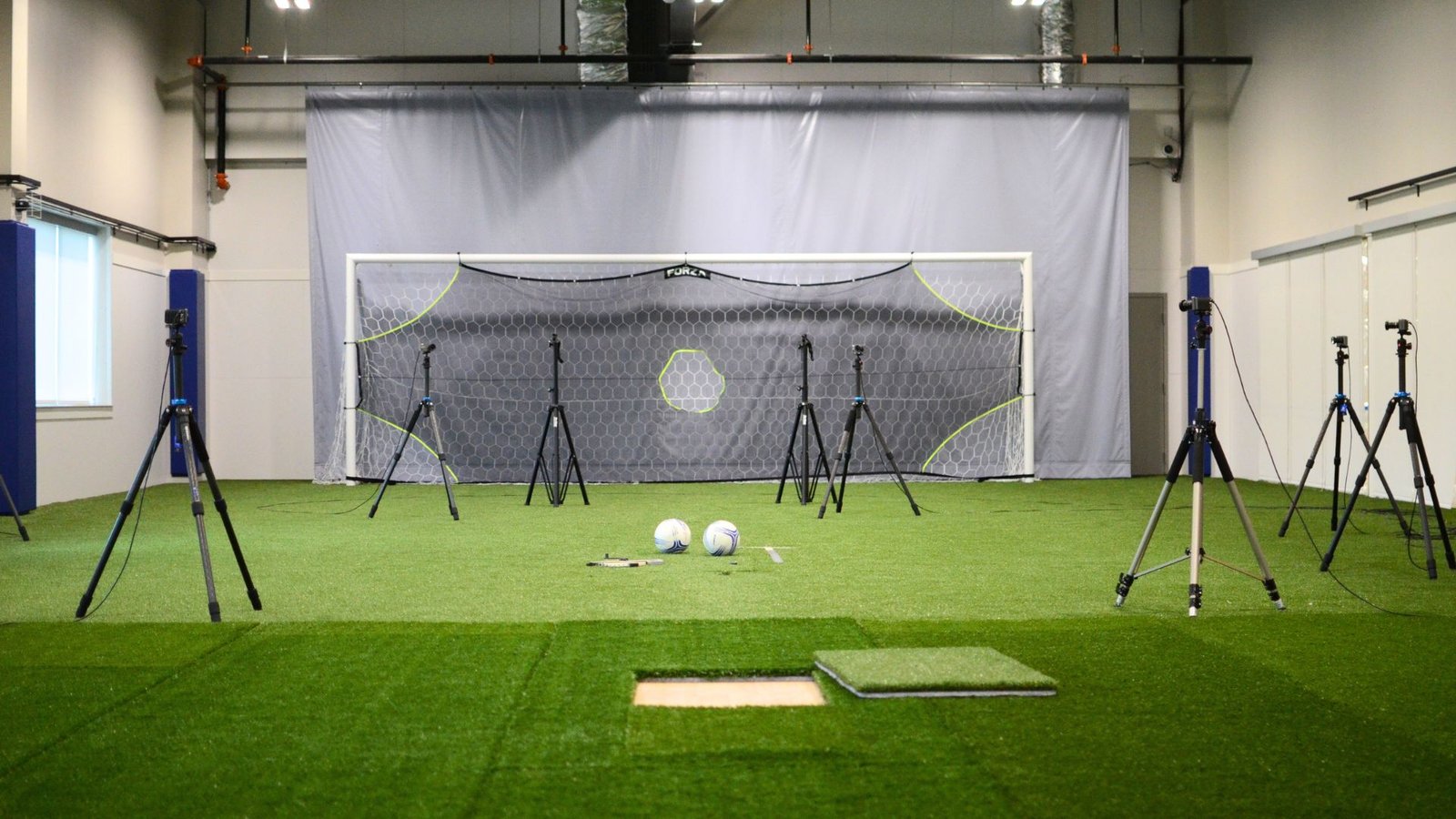
The Motion Analysis Lab at Synapse SRT helps answer questions that observation alone cannot. Located inside Sawmill Sports Hub in Willowbrook, Illinois, the lab combines 3D movement tracking, force measurement & wireless muscle-activation technology to provide a more detailed understanding of athletic movement.
For athletes, clinicians, coaches & researchers, that information can turn a familiar action—a jump, cut, sprint or throw—into a useful starting point for performance development, rehabilitation planning & further investigation.
What Is the Motion Analysis Lab?
The Motion Analysis Lab is Synapse Sports & Rehab Technologies’ dedicated biomechanics testing environment inside Sawmill Sports Hub. It brings together specialized cameras, force plates, muscle-tracking equipment & sport-specific testing spaces to evaluate how athletes move.
Synapse SRT occupies approximately 8,000 square feet within Sawmill, including 3,200 square feet dedicated to motion analysis. The setting connects laboratory measurement with athletic actions performed on turf and court surfaces, rather than limiting assessments to a traditional examination room.
Located at 17W411 S Frontage Rd. in Willowbrook, Sawmill houses this technology in DuPage County, near communities including Darien, Burr Ridge, Downers Grove, Hinsdale & Westmont.
Technology That Reveals How Athletes Move
A movement has several layers: the position of the body, the forces acting on it & the muscles contributing to the action. The lab’s technology measures these different elements, allowing the Synapse SRT team to examine a movement from more than one perspective.
3D Motion Capture: Tracking Movement
The lab uses two complementary approaches to 3D motion capture. Markerless tracking allows athletes to move without markers attached to their bodies, while marker-based tracking uses placed markers for detailed movement measurement.
- Markerless system: Eight modular OptiTrack Prime Color cameras paired with Theia3D software.
- Marker-based system: Twenty mounted OptiTrack Prime cameras integrated with Motive by OptiTrack software.
These systems provide data about movement patterns & joint positions that can help clarify what happens during a complex athletic action. Instead of relying only on a visual impression of technique, an assessment can examine measurable differences in how the athlete moves.
Force Plates: Measuring the Push Behind the Play
Four AMTI force plates, arranged in two pairs, measure ground reaction forces—the forces exchanged between the athlete & the surface beneath them. These measurements help assess force production, balance & the demands of movements such as jumping and landing.
For example, a landing assessment can examine whether an athlete loads each leg differently. That finding does not explain everything on its own, but it gives the evaluating team a specific question to investigate alongside movement data and clinical findings.
Wireless EMG: Examining Muscle Activation
The Delsys Trigno wireless EMG system measures electrical activity associated with muscle activation. This adds information about muscular timing & activation patterns during a task.
Together, motion capture, force plates & EMG help connect three important questions: how did the athlete move, what forces were involved, and how did the muscles contribute?
A Testing Space Built Around Sport
Movement testing becomes more relevant when athletes can perform actions that resemble the demands of their sport. Inside Sawmill, the lab’s surfaces & equipment provide room to evaluate more than isolated exercises.
The performance area features Nex Field X-Gen E2 Pro turf, with a total turf footprint of 3,200 square feet divided into 2,200 square feet of permanent turf & 1,000 square feet of modular space. A dedicated 1,200-square-foot Taraflex court supports court-sport movement and agility assessments.
- Basketball: A regulation hoop supports vertical-jump & shooting-mechanics assessments.
- Volleyball: A custom net supports evaluation of spikes, blocks & lateral movement.
- Soccer: A full-size goal provides a setting for soccer-specific movement testing.
- Multisport movement: Flexible configurations support assessment of sprinting, cutting, jumping & throwing.
This setup helps the lab connect controlled measurement with the movements athletes recognize from practice and competition.
How Motion Analysis Supports Athletes
The value of the Motion Analysis Lab is not simply the amount of data it collects. It is how that information can help answer a specific question about an athlete’s performance, rehabilitation or movement mechanics.
Building a Biomechanical Baseline
Baseline profiling documents force production, movement patterns & joint mechanics during selected tasks. These measurements create a reference point for tracking changes and informing individualized training or physical therapy planning.
Examining Injury-Related Movement Factors
Screenings can identify loading patterns, asymmetries & movement characteristics that may warrant closer evaluation. Findings can inform injury-risk management strategies, but they do not predict every injury or guarantee prevention.
Tracking Rehabilitation & Return-to-Play Progress
After an injury, an athlete may feel ready before their movement capacity has fully recovered. Objective testing can help document progress and evaluate how they perform tasks relevant to their sport.
Return-to-play findings support a broader clinical decision that considers recovery, symptoms & sport demands. No single test can establish a risk-free return to competition.
Assessing Sport-Specific Mechanics
Detailed analysis of sprinting, jumping, cutting & throwing can reveal movement characteristics worth addressing in training. The purpose is to make development more specific: identifying what to work on and measuring how the athlete responds over time.
Testing Sports Technology Claims
The lab also supports independent evaluation of sports equipment, wearables & footwear. Structured testing using motion capture and force measurements gives researchers a way to investigate product claims with objective data.
Explore the Lab Inside Sawmill
The Motion Analysis Lab sits alongside the Synapse Brain Gym, a 1,200-square-foot neural training room with 20 Neurovisualization Feedback Training stations. Offices, a conference room & a team lounge provide space to review findings and collaborate on research and athlete care.
For Sawmill Sports Hub, housing Synapse SRT connects athletic participation with a deeper understanding of performance. Within the same facility where players practice and compete is a specialized environment examining the mechanics behind those movements.
The game shows us what an athlete can do. Motion analysis helps us understand how they do it.
Visit Sawmill Sports Hub to explore the facility, or learn more about assessments & research through Synapse SRT’s Motion Analysis Lab. For photos and videos of the facility & technology inside Sawmill, follow @sawmillsportshub on Instagram.